The design of non-trivial technical systems is more efficient and less risky when the effect of design decisions can be estimated early. Model-based performance and dependability evaluation is an important help. In the area of computer-controlled technical systems, numerous model classes within the field of stochastic discrete event systems have been proposed. Stochastic Petri nets and their variants are widely accepted today as a mature tool for describing systems exhibiting concurrency, resource restrictions, synchronization, time-dependency, and probabilistic behavior.
TimeNET is a software tool for the modelling and analysis of stochastic Petri nets with non-exponentially distributed firing times. It supports graphical modeling of uncolored and colored Petri nets as well as Markov chains. Numerous performance evaluation and structural analysis algorithms are available as well as an interactive token game. A list of functions and some example screen shots are available on the Features page.
TimeNET is developed and maintained by the Systems and Software Engineering group at Technische Universität Ilmenau, Germany. Further notes on its history can be found in the user manual.
How to get TimeNET
The tool is free of charge for non-commercial use. Companies interested in the tool or anybody planning to use it in a commercial context should contact Armin Zimmermann for a licence.
To download the software, please register as a user via this web site for access. As a registered user you get access to the tool installer, user manual and example models.
What is a Petri Net?
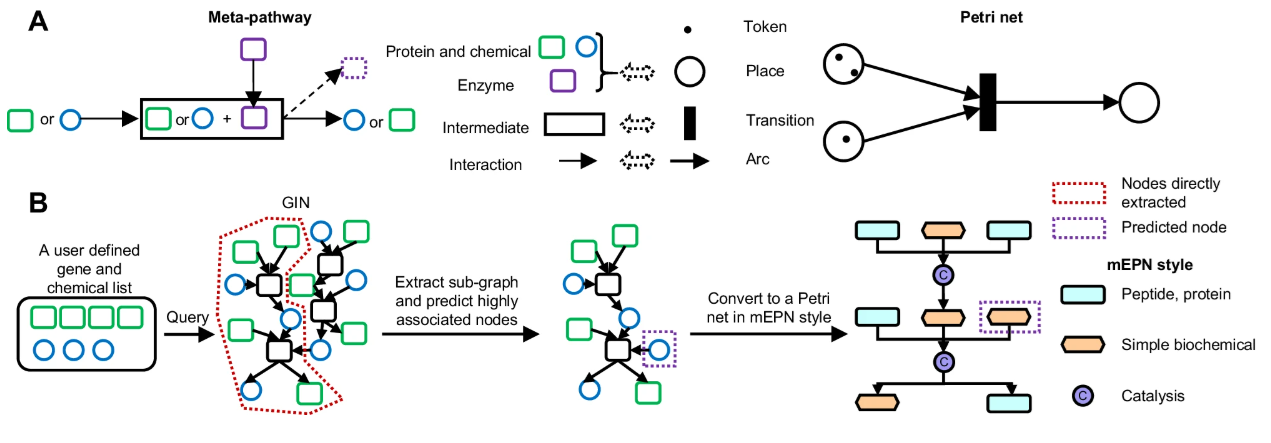
A Petri net is a graphical and mathematical modeling tool consisting of places, transitions, and arcs. Input arcs connect places with transitions, while output arcs start at a transition and end at a place. Places can contain tokens; the current state of the modeled system is given by the number of tokens in each place.
The concept has its origin in Carl Adam Petri's dissertation in 1962 at the Technische Universität Darmstadt, Germany.